
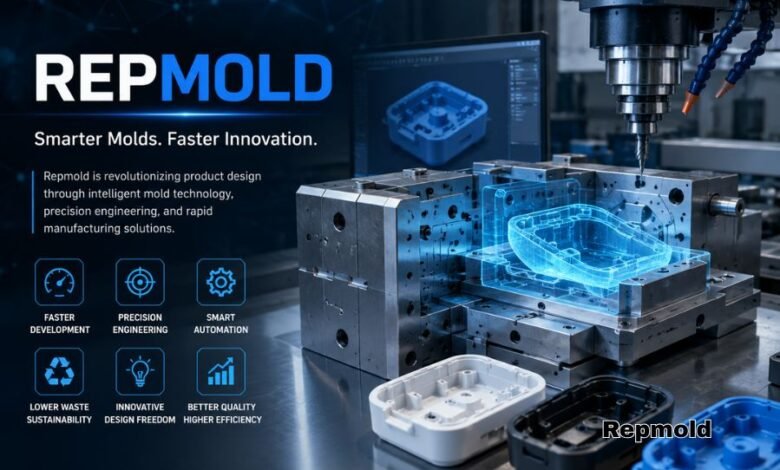
In today’s fast-moving industrial world, businesses are constantly searching for ways to manufacture products faster, cheaper, and with greater precision. Traditional mold-making methods, while reliable, often require significant time, labor, and investment. This is where Repmold enters the conversation as a modern solution that combines rapid prototyping, digital design, and precision manufacturing into a smarter production system.
The term “Repmold” has recently gained attention across industries such as automotive, aerospace, medical devices, electronics, and consumer products. It represents a new approach to mold manufacturing where speed, flexibility, and efficiency work together to improve product development cycles.
This article explores what Repmold is, how it works, its advantages, industrial applications, challenges, and why it is becoming a critical technology in the future of manufacturing.
What Is Repmold?
Repmold is a modern manufacturing concept focused on rapid and repeatable mold creation. The name itself combines two ideas:
- Rep = Repeat, replicate, or rapid
- Mold = A structure used to shape products or components
Together, Repmold refers to a system where molds are produced quickly and accurately using digital manufacturing tools and advanced materials.
Unlike traditional mold-making, which can take weeks or even months, Repmold shortens the production cycle significantly. Manufacturers can create prototype molds, test products, modify designs, and move toward production much faster than before.
The core philosophy behind Repmold is simple:
- Faster design validation
- Lower tooling costs
- Reduced material waste
- Flexible production
- High precision manufacturing
This makes Repmold especially useful for industries that require rapid innovation and frequent design changes.
The Evolution of Mold Manufacturing
To understand why Repmold matters, it’s important to look at traditional mold manufacturing.
For decades, industries relied heavily on steel and aluminum molds created through machining processes. These molds were durable and excellent for mass production, but they came with several limitations:
- High setup costs
- Long production times
- Limited design flexibility
- Expensive modifications
- Large material waste
If a company needed even a small design change, engineers often had to rebuild major sections of the mold. This increased both cost and development time.
As industries became more competitive, companies needed faster ways to test ideas and launch products. The rise of CAD software, 3D printing, and digital manufacturing created the foundation for Repmold technology. Instead of relying entirely on heavy machining, manufacturers could now design and produce molds digitally and refine them rapidly.
This shift transformed manufacturing from a slow linear process into a flexible and adaptive system.
How Repmold Works
The Repmold process combines several modern technologies into one integrated workflow. While exact methods vary between industries, the general process follows these stages:
1. Digital Product Design
Everything begins with a digital 3D model created using CAD (Computer-Aided Design) software.
Engineers design the product with precise dimensions, surface textures, and structural requirements. Digital simulations are often used to test:
- Stress resistance
- Heat performance
- Material flow
- Product durability
This virtual testing helps identify problems before physical production begins.
2. Rapid Prototyping
Once the design is finalized, manufacturers create an early prototype using technologies such as:
- 3D printing
- CNC machining
- Resin casting
- Additive manufacturing
This stage allows engineers to physically examine the design and make adjustments quickly.
Traditional manufacturing might require weeks for this step, but Repmold can often complete prototypes within days.
3. Mold Replication
The next stage involves creating the actual mold.
Instead of machining a complete steel mold from scratch, Repmold often uses:
- Epoxy molds
- Silicone molds
- Hybrid composite molds
- High-performance polymers
These materials reduce both production time and tooling costs.
The mold captures highly detailed geometry while remaining durable enough for low-to-medium production runs.
4. Testing and Iteration
After mold creation, manufacturers test the product under real-world conditions.
If improvements are needed, engineers simply modify the digital design and create an updated mold quickly. This rapid iteration process is one of Repmold’s greatest strengths.
5. Production
Once approved, the mold is used for manufacturing final products.
Repmold supports:
- Short-run production
- Bridge tooling
- Prototype manufacturing
- Customized product creation
- Limited commercial production
This flexibility allows businesses to produce only what they need without large upfront investments.
Major Benefits of Repmold
Repmold is becoming increasingly popular because it solves many problems associated with traditional manufacturing.
1. Faster Production Speed
Speed is the biggest advantage of Repmold.
Traditional molds can require months of development, while Repmold systems can often produce molds in days.
This shorter timeline helps businesses:
- Launch products faster
- Respond quickly to market changes
- Reduce development bottlenecks
- Improve innovation cycles
In competitive industries, faster time-to-market creates major advantages.
2. Lower Manufacturing Costs
Traditional tooling can be extremely expensive, especially for startups or small businesses.
Repmold reduces costs through:
- Less material usage
- Faster tooling
- Reduced labor
- Simplified modifications
- Lower prototype expenses
Companies can test multiple ideas without risking massive financial losses.
3. Design Flexibility
Modern products often require continuous updates and customization.
Repmold allows manufacturers to:
- Modify designs rapidly
- Test multiple versions
- Create custom products
- Produce small personalized batches
This flexibility is essential in industries where customer preferences change rapidly.
4. High Precision and Accuracy
Because Repmold uses digital modeling and advanced fabrication tools, it delivers exceptional precision.
This accuracy is critical in industries such as:
- Medical technology
- Aerospace engineering
- Electronics manufacturing
- Automotive systems
Even tiny measurement errors can affect product performance, making precision extremely important.
5. Reduced Material Waste
Traditional manufacturing often produces excess waste during machining.
Repmold minimizes waste by:
- Using additive manufacturing
- Producing molds only when needed
- Supporting on-demand manufacturing
- Reducing failed prototypes
This supports environmentally sustainable manufacturing practices.
Technologies Behind Repmold
Several advanced technologies power the Repmold ecosystem.
CAD Software
Computer-Aided Design software creates precise digital product models.
Popular CAD tools include:
- SolidWorks
- AutoCAD
- Fusion 360
- CATIA
These systems allow engineers to visualize products before manufacturing begins.
3D Printing
3D printing is one of the most important components of Repmold.
It enables rapid creation of:
- Prototype molds
- Product samples
- Complex geometries
- Custom components
3D printing dramatically reduces development time.
CNC Machining
CNC machines provide precision cutting and shaping.
Repmold often combines CNC machining with additive manufacturing for hybrid production methods.
Additive Manufacturing
Additive manufacturing builds objects layer by layer, reducing waste and allowing highly detailed designs.
This technology supports:
- Faster prototyping
- Lightweight structures
- Complex internal geometries
- Customization
Simulation and AI
Modern Repmold systems increasingly use:
- AI-assisted design optimization
- Digital twins
- Predictive simulations
- Automated quality control
Artificial intelligence helps manufacturers improve efficiency and reduce errors.
Industrial Applications of Repmold
Repmold technology serves a wide range of industries.
Automotive Industry
The automotive sector constantly develops new components and vehicle designs.
Repmold helps manufacturers:
- Prototype engine components
- Test dashboard designs
- Create interior parts
- Reduce development costs
Automotive companies benefit from faster product testing and shorter production cycles.
Aerospace Industry
Aerospace engineering demands extreme precision and lightweight materials.
Repmold supports:
- Aircraft component testing
- Lightweight structural designs
- Rapid iteration of prototypes
- Low-volume precision manufacturing
This improves both safety and innovation.
Medical Industry
Medical technology requires high accuracy and strict safety standards.
Repmold enables:
- Surgical tool prototypes
- Customized implants
- Medical device testing
- Small-batch production
Healthcare companies can bring innovations to market faster while maintaining quality standards.
Consumer Electronics
Electronics manufacturers operate in highly competitive markets with short product lifecycles.
Repmold allows companies to:
- Test smartphone casings
- Prototype wearable devices
- Create ergonomic designs
- Improve production flexibility
Faster product development helps companies stay competitive.
Consumer Goods
From kitchen appliances to sports equipment, Repmold improves consumer product manufacturing through:
- Rapid design testing
- Affordable prototyping
- Product customization
- Faster market launch
This helps businesses respond quickly to customer trends.
Repmold and Sustainability
Sustainability has become a major concern in manufacturing.
Traditional manufacturing methods consume significant energy and produce large amounts of waste. Repmold offers a more eco-friendly alternative.
Reduced Waste Production
Because Repmold uses digital manufacturing and additive methods, it reduces excess material waste.
Manufacturers only produce what is necessary.
Energy Efficiency
Shorter production cycles require less machine operation time, reducing overall energy consumption.
On-Demand Manufacturing
Repmold supports on-demand production instead of large-scale overproduction.
This helps companies avoid unnecessary inventory waste.
Eco-Friendly Materials
Many Repmold systems are beginning to incorporate:
- Recyclable polymers
- Bio-based materials
- Sustainable composites
This aligns with global environmental goals.
Challenges and Limitations of Repmold
Despite its advantages, Repmold also faces certain challenges.
Limited Durability
Prototype molds created through Repmold may not last as long as hardened steel molds.
For extremely high-volume manufacturing, traditional molds may still be preferred.
Material Constraints
Some high-performance industrial materials remain difficult to process through rapid mold systems.
This can limit certain applications.
Technical Expertise
Implementing Repmold requires skilled engineers familiar with:
- CAD software
- 3D printing systems
- CNC machining
- Digital manufacturing workflows
Training and expertise are essential for successful adoption.
Initial Equipment Investment
Although Repmold reduces long-term costs, advanced manufacturing equipment can still require substantial initial investment.
However, costs continue to decline as technologies improve.
The Future of Repmold
The future of Repmold looks extremely promising.
Several emerging trends are expected to accelerate its growth.
AI Integration
Artificial intelligence will improve:
- Automated mold optimization
- Predictive maintenance
- Design simulations
- Quality control
AI-driven systems will make manufacturing even faster and more accurate.
Smart Factories
Repmold fits naturally into Industry 4.0 environments where machines, software, and automation systems work together.
Smart factories will increasingly depend on flexible manufacturing methods like Repmold.
Advanced Materials
Researchers are developing stronger and more durable materials for rapid mold systems.
Future Repmold solutions may rival traditional steel molds in durability.
Increased Customization
Consumers increasingly demand personalized products.
Repmold allows manufacturers to produce customized goods efficiently without massive costs.
This trend will continue to expand in:
- Fashion
- Medical technology
- Electronics
- Automotive accessories
Why Repmold Matters Today
Modern industries operate in an environment where speed, innovation, and flexibility determine success.
Companies can no longer afford:
- Long production delays
- Excessive tooling expenses
- Slow design changes
- Wasteful manufacturing processes
Repmold addresses these problems directly by combining digital design with rapid production systems.
It empowers businesses to:
- Innovate faster
- Reduce risk
- Improve product quality
- Lower costs
- Adapt quickly to market demands
As technology advances further, Repmold is expected to become a standard part of modern manufacturing strategies.
Conclusion
Repmold represents a major shift in how products are designed, tested, and manufactured. By integrating rapid prototyping, digital engineering, and precision mold creation, it offers a smarter alternative to traditional manufacturing methods.
Its ability to reduce production time, lower costs, improve flexibility, and support sustainability makes it one of the most exciting developments in modern industry.
From automotive and aerospace engineering to medical devices and consumer electronics, Repmold is helping companies innovate faster than ever before. While challenges still exist, ongoing improvements in materials, AI, and digital manufacturing will continue expanding its capabilities.